Reciprocating Saw vs. Oscillating Saw: Differences, Blades and Applications
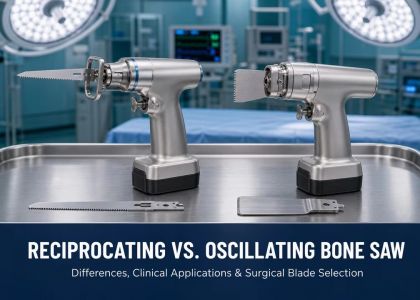
Power saw systems are widely used in orthopedic procedures where controlled bone cutting is required. Two commonly used configurations are the Reciprocating Saw and Oscillating Saw. Although both use powered movement to drive a surgical blade, their cutting mechanisms and blade designs are different.
Understanding these differences can help hospitals, distributors and medical device buyers select suitable saw systems and compatible consumables for different surgical requirements.
How Does a Reciprocating Saw Work?
A Reciprocating Saw moves the blade rapidly back and forth along a linear path. The blade teeth repeatedly travel forward and backward to create the cutting action.
Reciprocating saws can be used for applications that require a relatively narrow cutting path and controlled linear blade movement. The blade design, tooth configuration, working length and connection type can vary according to the intended application and power-tool system.
How Does an Oscillating Saw Work?
An Oscillating Saw produces a rapid angular movement at the blade tip rather than a linear back-and-forth stroke. The blade moves through a small arc, allowing the cutting edge to work within a relatively controlled area.
Oscillating saws are commonly associated with orthopedic bone-cutting applications. Their blades are available in different widths, thicknesses, tooth configurations and connection designs to accommodate different surgical procedures.
Reciprocating Saw vs. Oscillating Saw
| Feature | Reciprocating Saw | Oscillating Saw |
|---|---|---|
| Blade movement | Linear back-and-forth movement | Rapid angular oscillation |
| Blade design | Linear cutting teeth | Various straight or shaped cutting edges |
| Typical use | Applications requiring reciprocating cutting | Controlled orthopedic bone cutting |
| Consumables | Reciprocating saw blades | Oscillating saw blades |
Choosing the Right Surgical Saw Blade
The saw blade is an important part of the overall cutting system. For a Reciprocating Saw, blade selection may consider blade length, width, tooth configuration and connection type. For an Oscillating Saw, blade width, thickness, cutting angle and tooth design are commonly considered.
Blade compatibility with the corresponding handpiece or power-tool system should also be confirmed before use. Different procedures may require different blade dimensions and cutting characteristics.
Well Trust Surgical Saws and Consumables
Well Trust provides surgical power saw products and related consumables for orthopedic applications. Our product range includes Reciprocating Saw systems, Oscillating Saw systems and corresponding surgical saw blades.
In addition to saw handpieces and blades, Well Trust also supplies related accessories and consumables such as rechargeable batteries and other power-tool components. This product range allows customers to source the main saw equipment together with compatible consumables and supporting components.
For distributors, hospitals and medical device companies, Well Trust can provide different product configurations according to the required specifications and power-tool platform. Customers can contact our team for product models, blade specifications and compatibility information.
Frequently Asked Questions
What is the main difference between a Reciprocating Saw and an Oscillating Saw?
A Reciprocating Saw uses linear back-and-forth blade movement, while an Oscillating Saw uses rapid angular movement.
Are Reciprocating Saw Blades and Oscillating Saw Blades interchangeable?
Not necessarily. Blade connection, dimensions and compatibility depend on the specific power-tool system, so the applicable model should be confirmed before selection.
What products does Well Trust provide?
Well Trust provides Reciprocating Saw and Oscillating Saw systems, related surgical saw blades, batteries and other supporting consumables and accessories.
Conclusion
Reciprocating Saw and Oscillating Saw systems use different blade movements and are designed with different blade configurations. Selecting the appropriate saw requires consideration of the surgical application, blade specifications and power-tool compatibility. With saw systems, surgical saw blades, batteries and related consumables, Well Trust provides a range of products for orthopedic power-tool applications.


